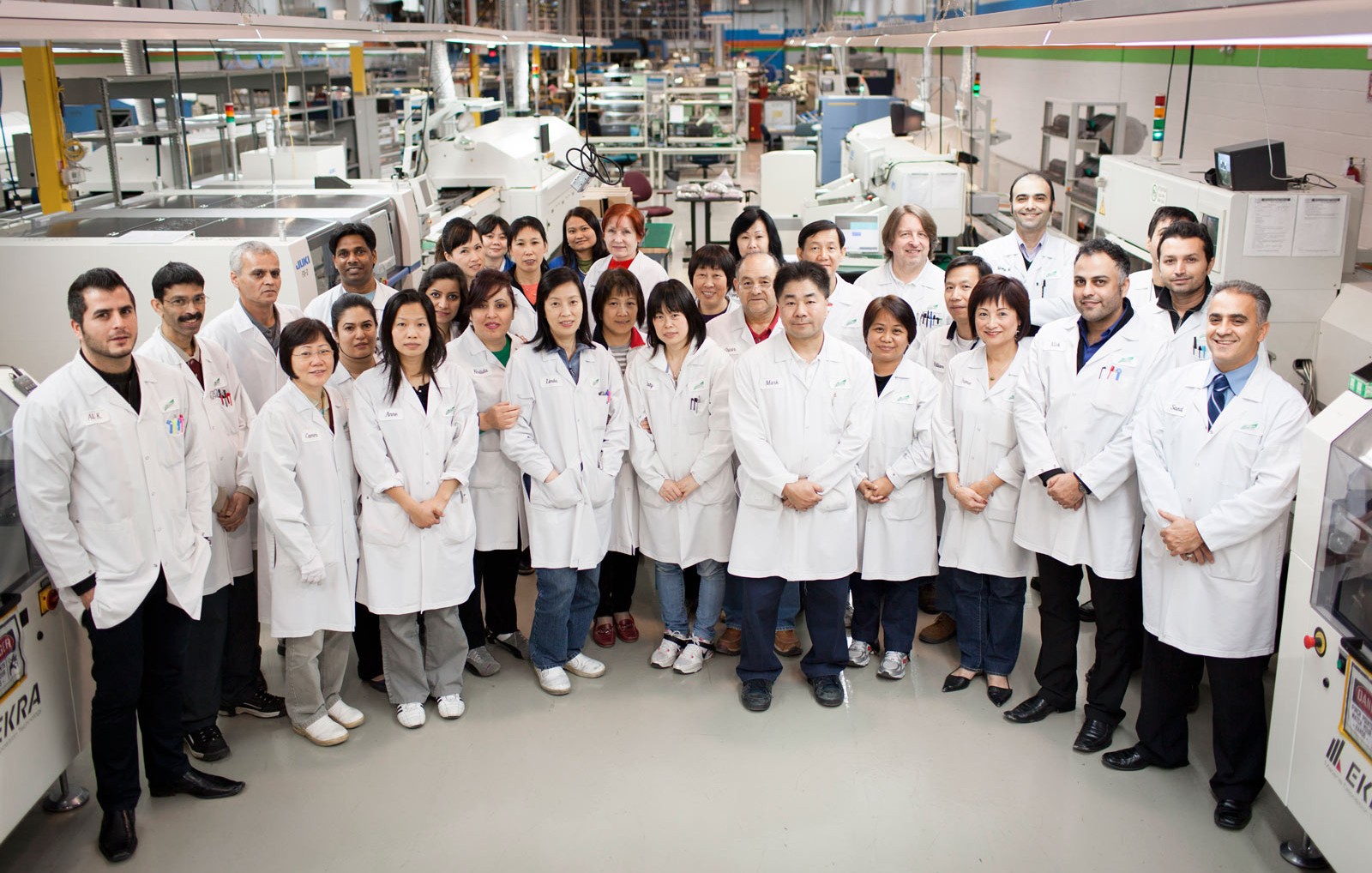
Built by people who turn practical ideas into electronics.
<p>MIS grew from a founder-led electronics company into a Richmond Hill manufacturing team with engineering, quality, assembly, testing, and innovation under one roof.</p>
A Canadian manufacturer shaped by risk, invention, and follow-through.
MIS takes its name from Masjid-i-Suleiman, the place that inspired founder Saeid Mohmedi's belief that careful risk and practical discovery can build something lasting. That origin still shows up in how the company supports customers: patient engineering, disciplined manufacturing, and a willingness to solve hard details.
1998Electronics ideas moving from concept into production
40,000sq ft design, engineering, assembly, and manufacturing plant
4 SMTproduction lines supporting modern PCB assembly
70+people across engineering, production, quality, and support
Founder's perspective
Customer delight, backed by honesty and integrity.
For founder Saeid Mohmedi, quality is more than a production checkpoint. It is a company-wide responsibility grounded in honest communication, continual improvement, and empowering people to act when they see a better way to serve the customer.
A message from Saeid Mohmedi
With over two decades in the business, our core values remain the same—we run our business with honesty and integrity while always striving to provide the best experience for our customers.
We don't just aim for customer satisfaction; we are in pursuit of a higher standard. We like to think of it as customer delight. Our approach to business is customer-centric, and we have established a solid infrastructure to support this.
Saeid Mohmedi, Founder, President & CEO
MIS is committed to fulfilling customer requirements in a way that meets or exceeds expectations. The company continually reviews its quality management system to improve service delivery, treats quality as the responsibility of every employee, and empowers its people to act when they see an opportunity to improve.
Why MIS
Fewer gaps, clearer communication, and disciplined execution.
Customers come to MIS for quality, responsiveness, affordability, flexibility, efficiency, and a team that can guide a project from concept to delivery without scattering the work across disconnected vendors.
End-to-end support
Design, prototypes, assembly, manufacturing, post-manufacturing, testing, packaging, and delivery can be managed as one connected path.
In-house guidance
Engineering and quality assurance specialists help customers think through feasibility, deployment, verification, revisions, and production readiness.
Quality systems
ISO 9001:2015 and ISO 13485:2016 registration support documented process control, review, corrective action, and customer confidence.
Cost and schedule control
MIS focuses on faster time-to-market, fewer uncertainties, lower total cost, and a local alternative to fragmented offshore manufacturing.
ESD discipline
ESD training, protected-area controls, work instructions, documentation, markings, and regular audits help protect sensitive electronics during production.
Customer care
MIS frames long-term partnerships around honesty, integrity, responsive communication, and a higher bar than basic customer satisfaction.
Innovation
Innovation at MIS is tied to manufacturable electronics.
MIS connects research, design, development, feasibility, prototyping, testing, and verification so promising ideas can become manufacturable products.
Practical innovation
MIS supports creators, engineers, and product teams that need help turning technical ideas into assemblies that can be built, tested, and delivered.
The company's innovation story includes experience with heartbeat authentication, LED lighting, nanobiophotonics and biomedical research, touchless automatic sensor faucet systems, emergency lighting, electric vehicles, consumer electronics, and mission-critical products. This range shows how MIS connects research, electronics, controls, and manufacturable product development.
For customers, the practical value is that MIS can help clarify feasibility, refine system details, reduce avoidable cost, and connect early design decisions to the realities of manufacturing.
Research to product
Support can begin while requirements are still forming and continue through prototype learning, validation, and production release.
Built with production in mind
Innovation is strongest when a concept can be documented, sourced, assembled, inspected, tested, packaged, and supported repeatedly.
Fingerprint-only authorization can be vulnerable because fingerprints are static and can be left behind on objects. HP Auth was developed to add a living biometric layer that connects authentication to heart dynamics rather than relying on static data alone.
HP Auth
HP Auth is an MIS-invented and patented authentication technology that combines fingerprint input with biometric signals from the user's heartbeat and skin.
Fingerprint-only authorization can be vulnerable because fingerprints are static and can be left behind on objects. HP Auth was developed to add a living biometric layer that connects authentication to heart dynamics rather than relying on static data alone.
HP Auth was developed for potential financial, security, government, consumer, and automotive applications. The technology combines multifactor authentication, card-contained biometric data, anti-spoofing measures, and privacy-oriented design. HP Auth and Enhanced PPG are MIS technology marks associated with U.S. Patent 10,076,920.
Combines fingerprint interaction with heartbeat and skin-based biometric signatures.
Uses a living signal as part of the authentication layer for stronger product integrity.
Keeps biometric data on the card rather than relying on external storage.
Prototype concepts included a payment card and fob, fingerprint and E-PPG sensing, local microcontroller logic, NFC control, and visible or audible verification cues.
LED Lighting
MIS has many years of electronics manufacturing experience in the lighting and LED industry, including products where photonics, controls, durability, and assembly quality matter.
LED and lighting programs bring their own manufacturing challenges: control integration, power choices, vibration and shock resistance, thermal considerations, color performance, and reliable assembly at production scale.
MIS experience includes LED driver assemblies, automotive lighting, solar-powered lighting, plasma lighting, light strips and chains, commercial lighting, and industrial signage. That history makes LED Lighting a natural part of the company's innovation story.
Support for electronics used in lighting controls, drivers, indicators, and integrated assemblies.
Experience with products that depend on photonics, compact form factors, and dependable output.
Manufacturing awareness for lighting products moving from prototype into repeatable builds.
Nanobiophotonics Research
The Nanobiophotonics & Biomedical Research Lab connects MIS with advanced research in nanotechnology, biomedical science, photonics, optical sensing, and clinical device development.
Established in 2017 as an integrated part of MIS Electronics, the Nanobiophotonics & Biomedical Research Lab focuses on advanced research and nanotechnology- and photonics-based clinical industrial devices for biomedical applications.
The lab's work connects electronics, optical systems, biomedical engineering, spectroscopy, imaging, nanomedicine, nano-biosensors, laser-tissue interaction, and specialized consulting for academic and commercial partners. It was established to build partnerships with academic institutions and commercial organizations while developing photonics- and nanotechnology-based clinical and industrial devices.
Professor Mohammad E. Khosroshahi directs the lab. His background includes applied physics and medical-laser research, more than 100 peer-reviewed papers, book and chapter authorship, and work across nanobiotechnology and biomedical devices. Research inquiries can be directed to m.khosro@miselectronics.com or the MIS office at extension 279.
Research areas include nanomedicine, tumor photothermal therapy, cancer diagnosis, bioimaging, and drug delivery.
Optical methods include LSPR, LIFS, LIBS, FTIR, SERS, photoacoustic spectroscopy, fluorescence microscopy, and UV-Vis spectroscopy.
Capabilities include lasers and optical systems, nanoparticle formulation, characterization, protein purification, immunoassays, and protocol development.
Lab team
The published MIS lab roster identifies Mohammad Khosroshahi, Vaughan Woll-Morison, Tiam Mohmedi, Yesha Patel, and Roxana Chabok.
Published research record
2022 — Photothermal deflection study of heat transfer in air and bioplasmonic solution and the effect of optical breakdown on protein structure.
2022 — Resonance plasmon-enhanced fluorescence and multiple stimulated Stokes Raman scattering in FITC-conjugated gold nanoparticles.
2022 — Conjugation and characterization of anti-HER2 breast-cancer biomarker antibodies on PEGylated gold nanourchins.
2022 — Non-destructive optical detection of breast-cancer biomarkers in blood serum using FT-NIR and SERS immunoassay.
2022 — Characterization of oriented HER2 antibodies immobilized on gold for targeted FTIR and SERS detection.
2022 — Non-destructive assessment of milk quality using pulsed UV photoacoustic, fluorescence, and near-FTIR spectroscopy.
2022 — Pulsed laser-induced heating in bioplasmonic solution using photoacoustic and probe-beam deflection techniques.
2022 — Deep-UV LED imaging and fluorescence spectroscopy of bovine serum albumin and gold-nanourchin solutions.
2022 — Near-IR guided fluorescence and thermal imaging of tissue subsurface targets using labelled gold nanourchins and protein contrast agents.
2021 — Photoacoustic characterization of protein interaction with gold nanourchins in phosphate-buffered saline.
2021 — Dynamic characterization of indocyanine-green-assisted dental-caries ablation using thermal imaging and fluorescence spectroscopy.
2021 — Visualization and fluorescence spectroscopy of fingerprints on glass using a 405 nm laser and phase-contrast microscopy.
2020 — Growth and characterization of oyster mycelium containing FITC-conjugated gold nanoparticles as a natural delivery vehicle.
2020 — Measurement of pulsed Nd:YAG laser-induced stress and dental-tissue plume using a PVDF photoacoustic sensor and plasma spectroscopy.
2019 — Spatial thermal distribution of gold nanourchins in saline using transverse probe-beam deflection and wavefront sensing.
2018 — Temperature effects on the optical properties of vegetable oils using UV-Vis and laser-fluorescence spectroscopy.
Instruments and equipment
Ductless hood
Type A2 biological safety cabinet
CO₂ incubator
Autoclave
Benchtop centrifuge
High-speed microcentrifuge
Vortex mixer
Orbital shaker
Magnetic stirring hot plate
NanoQuest near-IR FTIR spectrometer
Multi-cell and single-cell UV-Vis spectrometers
Eppendorf micropipettes
Phase-contrast and fluorescence microscopes
4–200 kHz beam chopper
OPO Nd:YAG laser at 266, 355, 532, and 1064 nm
Four-channel diode laser at 405, 488, 808, and 1064 nm
632 nm He-Ne laser
Optical analyser
Wavemeter
Dual power and energy meter
Delay generator
300 MHz digital oscilloscope
Function generator
1.0, 2.25, and 3.5 MHz immersion transducers
Research program
Projects have investigated cancer-biomarker detection, plasmonic and fluorescence sensing, photoacoustic and photothermal measurements, nanoparticle delivery, protein-corona dynamics, tissue imaging, fingerprint visualization, and optical-fibre sensors.
Patented work
The lab identifies U.S. patent work involving multimodal spectroscopic cancer-biomarker detection, nanoparticle-containing oyster mycelium as a delivery vehicle, and optical-fibre systems for early cancer-biomarker detection.
Biomedical optics
Methods include LSPR, LIFS, LIBS, PEF, FTIR, SERS, PTDS, photoacoustic spectroscopy, fluorescence and phase-contrast microscopy, wavefront sensing, and UV-Vis spectroscopy.
From laboratory to device
The research capability complements MIS engineering and manufacturing by connecting experiments, sensors, optical systems, electronics, prototypes, and potential clinical or industrial devices.
Touchless Faucets
MIS has designed and manufactured proximity-sensor and intelligent sanitary products, including touchless automatic sensor faucets and electronic control systems.
Touchless faucet work reflects MIS experience combining design, research, development, manufacturing, proximity sensing, controllers, and environmental control technology for residential and commercial sanitary products. The published MIS history describes long-term relationships across multiple vertical markets in more than 20 countries.
These systems focus on hygiene, water and energy savings, convenient use, easy installation and maintenance, durable finishes, reliable valve technology, and residential or commercial customer support. The product line has included chrome, brass, white, and duo-tone finishes.
Infrared double-sensor technology detects objects and activates water only when needed.
Control features include temporary-off, permanent-on, and a 24-hour sentinel rinse option.
The work combines electronic controls, practical industrial design, reliable operation, and product support infrastructure.
Hygiene and comfort
Touch-free operation reduces contact, keeps surfaces cleaner, provides adjustable temperature, and can use a wide double-sensor field, flexible connections, battery operation, and optional remote control.
Safety and durability
Low-voltage control, status indication, secure shut-off and reset functions, a bistable solenoid valve, tough brass housing, and vandal-resistant construction support demanding installations.
Water control
Infrared double-sensor electronics turn water on only when an object is detected. Temporary-off, continuous-run, and sentinel-rinse functions support cleaning, filling, and hygiene routines. Product information describes water and energy savings of up to 70% and a two-year warranty.
Product specifications
The published product information identifies 6 V DC control, an optional 230 V AC to 6 V DC supply, adjustable flow duration from 0.5 to 4 seconds, and water temperature up to 80°C.
Next step
See how the MIS process fits your program.
Explore services, industries, or send a build question directly to the team.